
Vision Lagging Behind? Here’s What To Do.
Have you ever felt like your eyes just can't keep up?
Maybe you're reading and the words seem to move. You turn your head and your vision feels delayed. You have trouble tracking a ball, feel “woozy” or “sloshy” in busy stores, or you can feel your eyes uncontrollably moving in the dark.
You might describe it as your vision lagging behind.
The issue may not be your eyesight alone. Your eyes, brain, and vestibular system have to work together to keep your vision stable—and when that system gets out of sync, things can feel off.
Your Eyes Don't Work Alone
Your brain is constantly combining information from your eyes, inner ears, and body to figure out where you are in space.
Your eyes tell your brain what you're looking at.
Your inner ears help detect how your head is moving.
Your body, including your neck and joints, provides additional information about your position.
Your brain has to combine all of these signals quickly and accurately.
When that system isn't working efficiently, your vision may feel delayed, blurry, jumpy, or difficult to control.
Lagging vision is caused by a lot of different factors. Age, overwhelmed nerves, concussions, certain injuries, and other vestibular disorders are some of the most common factors we see in our clinic.
What Does "Vision Lagging" Feel Like?
Vision problems related to vestibular or oculomotor dysfunction don't always look like traditional blurry vision.
You might notice:
Trouble keeping your eyes on a moving object
Words seeming to move or bounce on the page
Blurry vision when you move your head
Trouble tracking a ball during sports
Headaches or eye fatigue after visual tasks
Difficulty switching your focus between objects
Nausea when watching fast-moving scenes
Why Does This Happen?
Your eyes have to make incredibly precise movements to keep you visually locked onto an object.
For example, imagine you're playing catch.
Your eyes need to smoothly follow the ball as it moves through the air. At the same time, your brain is processing information about your head and body movement so you can predict where the ball will be.
That's a lot of information to process at once.
After a concussion or other vestibular problem, skills such as smooth pursuits, saccades, convergence, and the vestibulo-ocular reflex (VOR) can become less efficient.
Research has found that problems with these eye-movement and vestibular functions can be associated with longer recovery after concussions or dysfunctions.
What Should You Do If You Have Lagging Vision?
The first step isn't necessarily to start doing random eye exercises from the internet.
The first step is figuring out what isn't working.
One way to work on this at home is to safely choose an everyday task that brings on your lagging vision. Try the task a few times and pay attention to how you feel each time. Does it become easier or less taxing with each repetition?
If it starts to feel better with each attempt, you can repeat the task 3–4 times. The goal is to stop while you’re feeling good—not push until your symptoms get worse.
If the task continues to feel worse or more taxing with each attempt, stop. That may be a sign that something else is preventing your brain from adapting, and repeatedly exposing yourself to that task could make your symptoms worse without providing a benefit.
A vestibular or concussion specialist can assess how your eyes and vestibular system are working together and determine whether your symptoms are coming from eye movement, visual motion sensitivity, balance, the inner ear, the neck, or a combination of these systems.
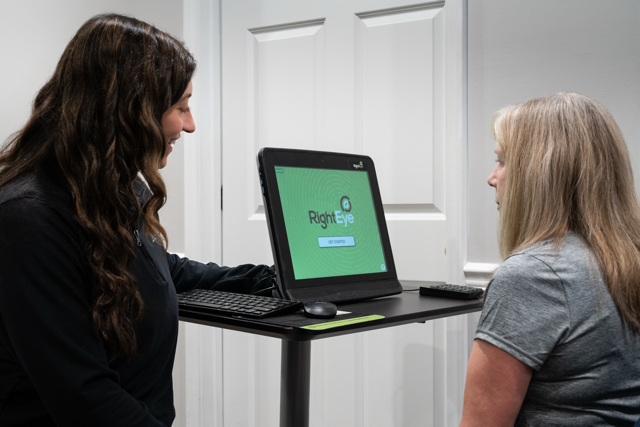
RightEye is a quick and easy screen that uses infrared technology to track your eyes as you are watching a target. In less than 5 minutes, RightEye will show you your eye deficits and areas for improvement. This is the same eye-tracking technology that LSU Football and Major League Baseball Teams use!
At Rebalance Physical Therapy, we use RightEye —along with other testing— to see how your visual system performs during different tasks and identify areas that may need attention.
From there, treatment can be specifically matched to what your brain needs.
That might include exercises designed to improve:
Eye tracking
Eye movement speed and accuracy
Focusing and convergence
Coordination between your eyes and head
Tolerance to visual motion
Balance and spatial awareness
The goal isn't simply to make your eyes move more.
It's to help your brain process visual information more efficiently so you can get back to doing the things you love.
Don't Just Push Through It
If reading, driving, working at a computer, exercising, or playing sports consistently makes you dizzy or gives you a headache, that's worth paying attention to.
You don't necessarily need to avoid those activities forever. In many cases, the goal of rehabilitation is to gradually improve your tolerance so your system can handle more without becoming overwhelmed.
And if these symptoms started after a concussion, don't assume you just have to wait them out. Persistent or worsening symptoms should be discussed with a healthcare provider, who may recommend evaluation by a specialist.
Your Vision Should Keep Up With Your Life
Your eyes and vestibular system are designed to work together automatically.
When that connection isn't working quite right, everyday activities can suddenly feel much harder than they should.
If your vision feels like it's lagging behind, there may be more to the story than your eyesight.
At Rebalance Physical Therapy, we specialize in finding those connections and creating a treatment plan based on how your system actually works.
Ready to figure out what's going on?
Schedule a free 15-minute phone consultation with one of our vestibular physical therapists to see if vestibular rehabilitation could be right for you.