
Why Do I Feel Drunk When I Haven’t Had Anything to Drink?
You're sober.
You know you're sober.
But you wake up and feel pulled to one side.
You can't walk a straight line to the bathroom or the kitchen.
Or straight doesn't feel straight anymore. You feel tilted when you're standing upright, so you adjust your body to feel level, and that's what throws you off
If that sounds familiar, you're in good company. In one widely cited analysis of U.S. national health data (Click Here for Analysis), about 35% of adults over 40 (roughly 69 million people) showed measurable signs of vestibular dysfunction on balance testing. A large German national survey found that nearly 23% of adults had moderate or severe dizziness in a given year (Click here for the Survey). Most of them won't describe it as spinning. Very often, people describe the feeling as "off," "floaty," "foggy," or, very often, "drunk."
Why Am I Feeling Drunk, But I Haven’t Had Anything to Drink?
Most people who describe this feeling say "drunk" because nothing else comes close. The sensation really does overlap with intoxication.
Alcohol slows down your vestibular system, and it dulls the cerebellum, the part of your brain that fine-tunes movement. With both suppressed, your brain gets slower, less accurate information about your head and body. That's why you sway, veer, and feel a step behind.
Now take the alcohol out of the picture. When your vestibular system is suppressed or not working efficiently for another reason, your brain ends up in the same position: working with unreliable signals.
The result is the same too:
Your eyes can't stay locked on a target when your head moves. Normally, an automatic reflex counter-rotates your eyes to keep the world steady as you walk or turn. When that reflex is slightly off, the scene wobbles or lags, and your vision feels like it isn't keeping up.
Your sense of where your body is doesn't match what you see and feel. When your eyes, inner ears, and body disagree, your brain can't settle on an answer. That can feel like swaying, drifting, being pulled to one side, or walking on a boat, and it's why you may overcorrect without realizing it.
Everything takes more brainpower. Balance is normally automatic. When the signals get noisy, your brain pulls in extra attention and effort to compensate, which is why this feeling often comes with fogginess, poor concentration, and fatigue.
Your nervous system doesn't have a separate sensation for "alcohol" and "signal problem."
It has one: something is off.
What Can Cause Vestibular Deficits?
There's no single culprit, which is part of what makes it so frustrating. Common contributors include:
Concussion and whiplash. Studies of young people with concussion have found that more than half show vestibular problems on testing, and dizziness and imbalance are among the most common symptoms.
Inner ear conditions, including those that cause a rocking or swaying sensation even when you're standing still.
Persistent postural-perceptual dizziness (PPPD). Often described as a chronic sense of floating or unsteadiness that's worse when upright or moving, it's estimated to account for roughly 1 in 5 patients seen in dizziness specialty clinics.
A lingering aftermath of illness, stress, or an earlier dizzy episode, where the brain never quite recalibrated.
The Part Nobody Talks About: What Other People Think.
For many of the people we work with, the physical sensation is only half of it. The other half is worrying about how it looks to others.
When you're veering in a hallway or can't walk a straight line, it's natural to wonder whether the people around you think you're drunk. You start focusing more on every step, looking around to make sure no one is seeing your struggle. That worry can turn into real anxiety. People start avoiding situations where they'll be seen walking.
If you've felt this, you're not being dramatic. It's one of the most common things patients tell us, and it's a very understandable reaction to a symptom that doesn't match how you feel inside.
Your Next Step: Give Your Brain a Safe Place to Retrain
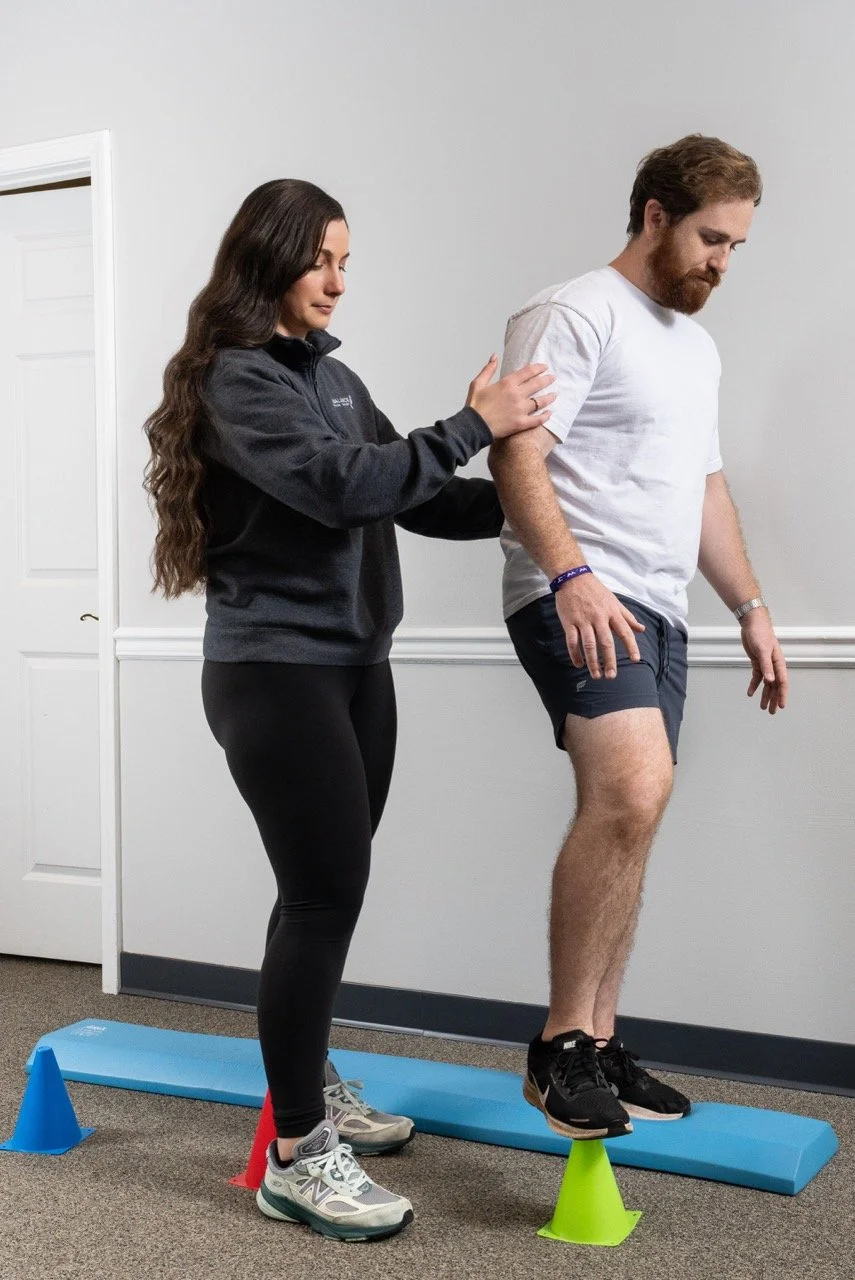
Your brain is remarkably adaptable, and that's exactly what vestibular rehabilitation takes advantage of. It gives your nervous system a controlled, safe environment to practice and strengthen the tasks it's been struggling with: coordinating your eyes and head, walking with turns, changing positions, and balancing without leaning too heavily on any one sense.
It isn't about pushing through misery. Exercises are matched to how your system responds, so your brain is challenged just enough to adapt. And noticing your own patterns, like when it's worse, what you were doing, and how you slept, gives us even more to work with.
At Rebalance Physical Therapy, we specialize in vestibular rehabilitation and helping people figure out what's really going on when movement stops feeling the way it used to. You're not imagining it, and you don't have to figure it out alone.
Because feeling steady shouldn't feel like a guessing game.